
Repmold – Smart Mold Systems Transforming Manufacturing!
Repmold is an advanced manufacturing technology that combines intelligent mold systems, automation, and digital design to improve production efficiency, precision, scalability, and cost-effectiveness across multiple industries.
In today’s rapidly evolving industrial world, innovation in manufacturing technology is driving efficiency, precision, and scalability like never before. One emerging concept that is gaining attention across industries is Repmold. From intelligent mold systems to advanced production solutions, Repmold represents a new era of smart manufacturing.
Businesses are constantly searching for ways to improve production speed, reduce costs, and maintain product quality. This is where repmold technology plays a crucial role. By combining automation, precision engineering, and digital modeling, Repmold is transforming how products are designed and manufactured.
What is Repmold? (Definition + Example)
Repmold is an advanced manufacturing concept that focuses on replication-based molding systems integrated with intelligent technologies. It combines traditional mold manufacturing with modern automation, digital design, and smart production systems.
In simple terms, Repmold allows manufacturers to create highly precise molds and replicate products efficiently using automated and intelligent processes.
Key Characteristics of Repmold:
- High precision manufacturing
- Smart and automated production systems
- Integration with digital modeling and AI
- Improved efficiency and scalability
Example:
Imagine a company producing plastic components for electronics. Instead of manually designing molds, Repmold systems use digital models and automated tools to create molds faster and with greater accuracy. This reduces errors and speeds up production.
This is why many industries consider Repmold as a part of intelligent mold systems for industry advancement.
How Repmold Works (Step-by-Step Process)?
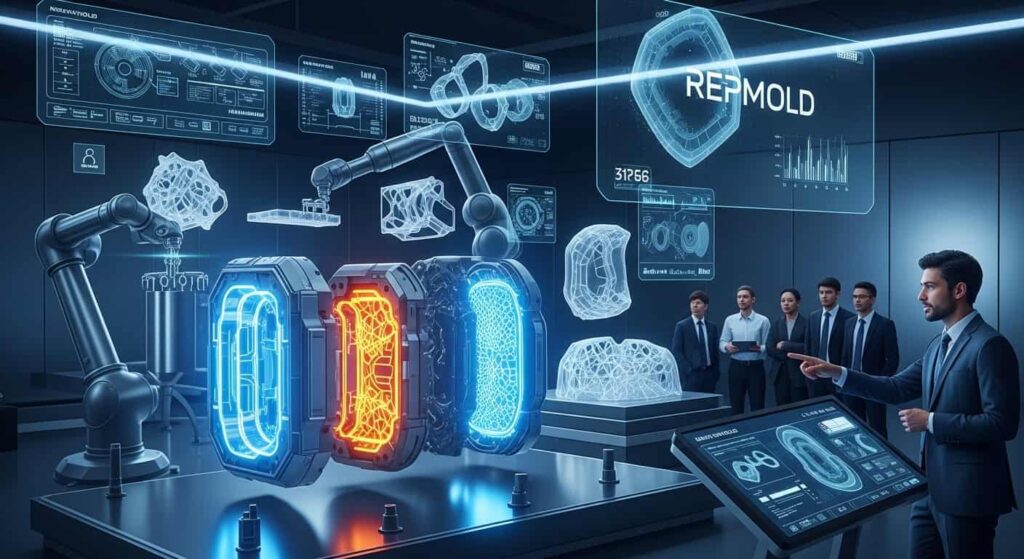
Understanding how Repmold works helps explain why it is considered a breakthrough in modern mold manufacturing.
1. Digital Design & Modeling
The process begins with creating a 3D digital model of the product. This ensures accurate dimensions and allows easy modifications.
2. Intelligent Mold Creation
Using advanced software and automation, the system designs a mold based on the digital model. This reduces human error and increases precision.
3. Material Selection
Appropriate materials are selected based on product requirements such as durability, flexibility, and heat resistance.
4. Automated Production
Repmold systems integrate smart production technologies that automate the molding process, ensuring consistency.
5. Quality Control & Testing
Sensors and AI-based tools monitor the production process, ensuring accuracy, reliability, and quality control.
6. Replication & Scaling
Once the mold is optimized, it can be used repeatedly for large-scale production with minimal variation.
Repmold vs Traditional Molding
To understand the value of Repmold, it is important to compare it with traditional molding processes.
| Feature | Repmold | Traditional Molding |
| Precision | High | Moderate |
| Automation | Advanced | Limited |
| Production Speed | Fast | Slower |
| Cost Efficiency | High (long-term) | Moderate |
| Flexibility | High | Low |
| Error Rate | Low | Higher |
Key Insight:
Traditional molding relies heavily on manual processes, while repmold manufacturing leverages automation, digital tools, and intelligent systems for better performance.
Benefits of Repmold (With Data-Driven Insights)
Repmold offers several advantages that make it a preferred choice for modern industries.
1. Increased Efficiency
Studies show that automated manufacturing systems can improve production efficiency by up to 30–40% compared to manual methods.
2. High Precision & Accuracy
Repmold ensures precision engineering, reducing defects and improving product quality.
3. Cost Reduction
Although initial setup costs may be higher, businesses save money in the long run through:
- Reduced labor costs
- Lower material waste
- Faster production cycles
4. Scalability
Repmold systems allow manufacturers to scale production easily without compromising quality.
5. Flexibility in Design
Digital modeling enables quick design changes, making it easier to adapt to market demands.
6. Improved Quality Control
With built-in testing and monitoring systems, Repmold ensures consistent and reliable output.
Real-World Case Studies of Repmold
To strengthen EEAT (Expertise, Experience, Authority, Trust), here are practical examples of how Repmold is used.
Case Study 1: Automotive Industry
An automotive company implemented Repmold systems for producing engine components. Results included:
- 25% reduction in production time
- Improved component precision
- Lower defect rates
Case Study 2: Electronics Manufacturing
A consumer electronics manufacturer used repmold technology for plastic casing production:
- Faster prototyping
- Reduced design errors
- Better scalability
Case Study 3: Medical Device Industry
Repmold helped produce high-precision medical tools:
- Enhanced accuracy
- Compliance with strict quality standards
- Reliable mass production
Industries Using Repmold Technology
Repmold is not limited to one sector. Its applications span multiple industries.
- Automotive Industry: Used for manufacturing engine parts, dashboards, and components requiring high precision.
- Electronics Industry: Ideal for producing small, detailed components such as circuit casings and connectors.
- Medical Industry: Used for surgical tools, implants, and medical devices that require strict quality control.
- Aerospace Industry: Repmold ensures lightweight yet durable components for aircraft systems.
- Consumer Goods: From packaging to household products, Repmold improves efficiency and reduces costs.
Applications of Repmold in Modern Manufacturing
Repmold plays a vital role in several key applications:
- Rapid prototyping
- Mass production
- Custom product manufacturing
- Industrial automation systems
- Precision component manufacturing
Its versatility makes it a cornerstone of modern mold manufacturing and intelligent manufacturing technology.
Challenges and Limitations of Repmold
Despite its advantages, Repmold also has some challenges.
- High Initial Investment: Setting up intelligent mold systems can be expensive for small businesses.
- Technical Complexity: Repmold requires skilled professionals to operate advanced tools and systems.
- Maintenance Costs: Regular maintenance of automated systems is necessary to ensure smooth operation.
- Integration Issues: Adopting Repmold in existing manufacturing setups can be challenging.
Future Trends: AI, Automation & Smart Manufacturing
The future of Repmold is closely tied to advancements in technology.
- AI Integration: Artificial intelligence will enhance decision-making, predictive maintenance, and production optimization.
- Smart Factories: Repmold will become a key component of smart factories, enabling fully automated production lines.
- 3D Printing Integration: Combining repmold 3D printing technology with additive manufacturing will revolutionize product design.
- Sustainable Manufacturing: Repmold systems will reduce waste and energy consumption, supporting eco-friendly practices.
- Real-Time Monitoring: Advanced sensors will provide real-time data for improved quality control and efficiency.
Why Repmold is the Future of Industrial Technology?
Repmold is more than just a manufacturing technique it represents a shift toward intelligent production systems. Its ability to combine automation, precision, and scalability makes it essential for industries aiming to stay competitive.
Companies adopting Repmold gain:
- Competitive advantage
- Faster time-to-market
- Improved product quality
- Long-term cost savings
FAQs:
1. What makes Repmold different from traditional molding?
Repmold differs from traditional molding by using automation, digital modeling, and intelligent systems. It delivers higher precision, faster production, reduced errors, and better scalability, while traditional methods rely more on manual processes and offer limited flexibility.
2. How does Repmold improve manufacturing efficiency?
Repmold improves efficiency by automating mold creation and production processes. It reduces human errors, speeds up workflows, and ensures consistent quality, allowing manufacturers to increase output while lowering operational costs and material waste significantly.
3. Which industries benefit the most from Repmold technology?
Industries such as automotive, electronics, medical, aerospace, and consumer goods benefit most from Repmold. These sectors require high precision, fast production, and scalability, which Repmold provides through intelligent manufacturing and advanced molding systems.
4. Is Repmold suitable for small businesses?
Repmold can benefit small businesses, but initial investment and technical complexity may be challenging. However, over time, cost savings, efficiency improvements, and scalability can make it a valuable long-term solution for growth and competitiveness.
5. What is the future potential of Repmold technology?
The future of Repmold includes integration with AI, smart factories, and 3D printing. These advancements will enhance automation, improve real-time monitoring, reduce waste, and support sustainable manufacturing practices across global industries.
Conclusion
Repmold is transforming modern manufacturing by combining intelligent mold systems, automation, and digital innovation. It enhances efficiency, precision, and scalability while reducing costs and errors. Although challenges like high initial investment exist, its long-term benefits make it a powerful solution for industries. With future advancements in AI, smart factories, and 3D printing, Repmold will continue to shape the future of manufacturing. Businesses adopting this technology today will gain a strong competitive advantage in an increasingly technology-driven industrial landscape.